
Optimize 1L Dual I-O:
Opdualag for Durable and
Superior Efficacy1,2*
Optimize 1L Dual I-O:
Opdualag for Durable and
Superior Efficacy1,2*
Actor portrayal.
*Based on the 13.2-month median final analysis, the primary endpoint of PFS was statistically significant; mPFS† was 10.1 months (95% CI: 6.4–15.7) with Opdualag vs 4.6 months (95% CI: 3.4–5.6) with nivolumab‡ (HR=0.75§; 95% CI: 0.62–0.92; P=0.0055). At the median follow-up of 19.3 months, the final analysis for the secondary endpoint of OS was not statistically significant (HR=0.80; 95% CI: 0.64–1.01; P=0.0593); threshold for significance was P<0.04302. ORR could not be formally tested based on testing hierarchy and was descriptively analyzed for Opdualag (43%; 95% CI: 38–48) vs nivolumab (33%; 95% CI: 28–38).1,3,4 †Assessed by BICR.1 ‡Kaplan-Meier estimate.1,2 §Based on stratified Cox proportional hazards model.1
All data shown below is 4-year data based on minimum potential follow-up of 45.3 months.2
Symbols represent censored observations.
4-year data2:
Primary analysis (19.3-month median follow-up)1,3:
Endpoints were tested in hierarchical order: PFS, OS, ORR.1
†Based on stratified Cox proportional hazards model.1
1L=first-line; BICR=blinded independent central review; CI=confidence interval; HR=hazard ratio; I-O=immuno-oncology; mMel=metastatic melanoma; mPFS=median progression-free survival; NR=not reached; ORR=overall response rate; OS=overall survival; PFS=progression-free survival.
4-year data based on minimum potential follow-up of 45.3 months.2
*In RELATIVITY-047, at the median follow-up of 19.3 months, the final analysis for the secondary endpoint of OS in the ITT population was not statistically significant (HR=0.80†; 95% CI: 0.64–1.01; P=0.0593); threshold for significance was P<0.04302.1,3 †Based on stratified Cox proportional hazard model.
Symbols represent censored observations.
4-year data2:
*Primary analysis (13.2-month median follow-up)4:
*Kaplan-Meier estimate.4 †Based on stratified Cox proportional hazards model.1 ‡Based on stratified log-rank test.4
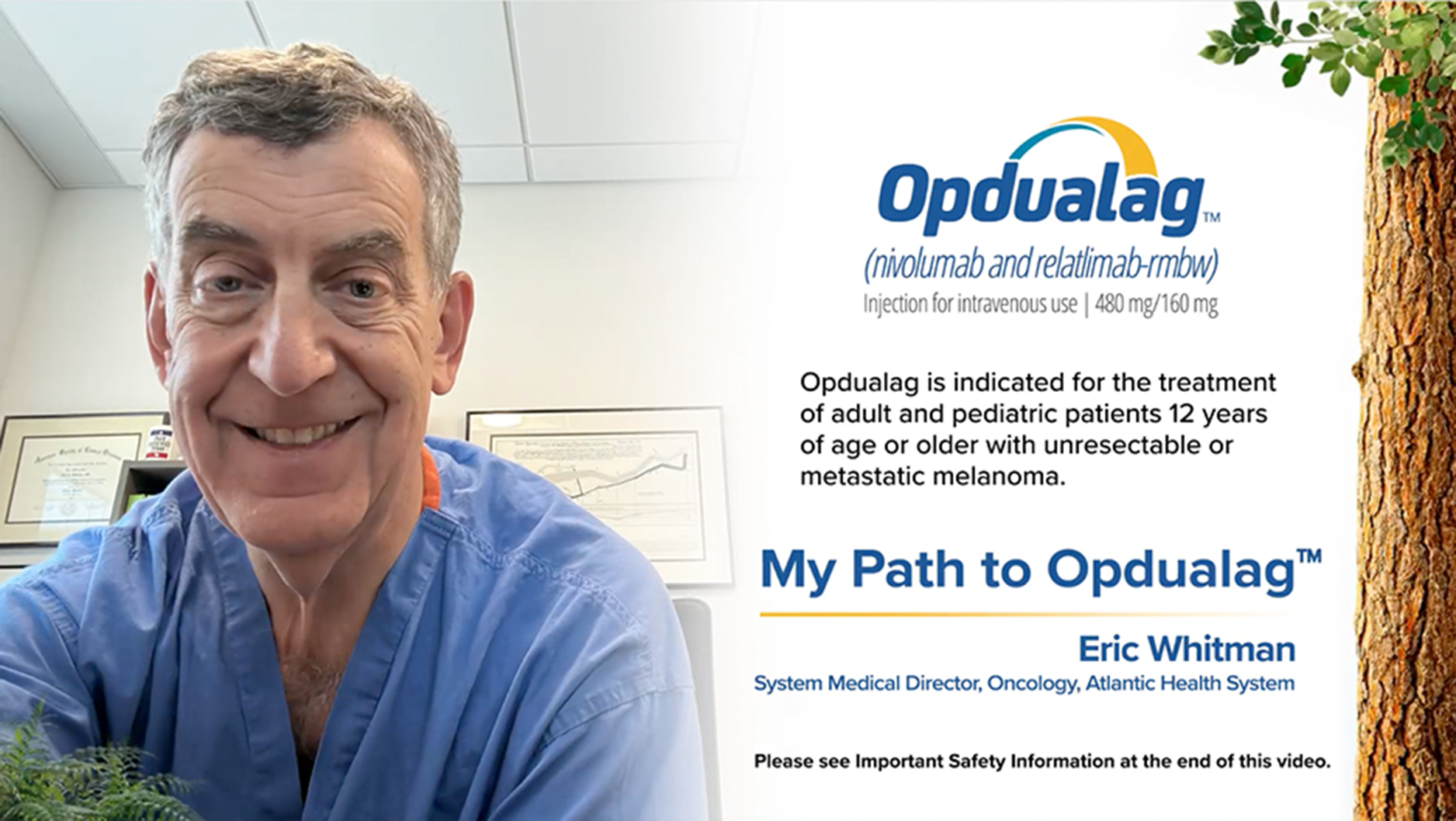
Hi, I'm Eric Whitman.
I'm a surgical oncologist specializing in melanoma and the System Medical Director of Atlantic Health System Oncology Program.
I've been practicing medicine for about 30 years.
I choose Opdualag for my melanoma patients with Stage III unresectable disease or metastatic Stage IV disease, based on the data from the Relativity 047 study.
The patients I choose to treat with Opdualag have unresectable Stage III melanoma or Stage IV melanoma, and they fit the general criteria laid out in the Relativity 047 study.
In our practice, we use generally accepted clinical guidelines to help guide our treatment decision making for metastatic or unresectable melanoma patients.
I think that healthcare providers considering treating their patients with Opdualag should review the data from the Relativity 047 study.
Indication:
Opdualag (nivolumab and relatlimab-rmbw) is indicated for the treatment of adult and pediatric patients 12 years of age or older with unresectable or metastatic melanoma.
Important Safety Information:
Severe and Fatal Immune-Mediated Adverse Reactions:
Immune-mediated adverse reactions (IMARs) listed herein may not include all possible severe and fatal immune-mediated adverse reactions. IMARs, which may be severe or fatal, can occur in any organ system or tissue.
IMARs can occur at any time after starting treatment with a LAG-3 and PD-1/PD-L1 blocking antibodies.
While IMARs usually manifest during treatment, they can also occur after discontinuation of Opdualag.
Early identification and management of IMARs are essential to ensure safe use.
Monitor patients closely for symptoms and signs that may be clinical manifestations of underlying IMARs.
Evaluate clinical chemistries, including liver enzymes, creatinine, and thyroid function at baseline and periodically during treatment.
In cases of suspected IMARs, initiate appropriate workup to exclude alternative etiologies, including infection.
Institute medical management promptly, including specialty consultation as appropriate.
Withhold or permanently discontinue Opdualag depending on severity.
Please see Section 2: Dosage and Administration in the accompanying Full Prescribing Information.
In general, if Opdualag requires interruption or discontinuation, administer systemic corticosteroid therapy (1 to 2mg/kg per day prednisone or equivalent) until improvement to Grade 1 or less.
Upon improvement to Grade 1 or less, initiate corticosteroid taper and continue to taper over at least one month.
Consider administration of other systemic immunosuppressants in patients whose IMARs are not controlled with corticosteroid therapy.
Toxicity management guidelines for adverse reactions that do not necessarily require systemic steroids, for example, endocrinopathies and dermatologic reactions, are discussed below.
Immune-Mediated Pneumonitis:
Opdualag can cause immune-mediated pneumonitis, which may be fatal. In patients treated with other PD-1/PDL-l blocking antibodies, the incidence of pneumonitis is higher in patients who have received prior thoracic radiation.
Immune-mediated pneumonitis occurred in 3.7% (13 out of 355) patients receiving Opdualag, including Grade 3 (0.6%) and Grade 2(2.3%) adverse reactions.
Pneumonitis led to permanent discontinuation of Opdualag in 0.8% and withholding of Opdualag in 1.4% of patients.
Immune-Mediated Colitis:
Opdualag can cause immune-mediated colitis, defined as requiring use of corticosteroids and no clear alternate etiology.
A common symptom included in the definition of colitis was diarrhea.
Cytomegalovirus infection or reactivation has been reported in patients with corticosteroid-refractory immune-mediated colitis.
In cases of corticosteroid-refractory colitis, consider repeating infectious workups to exclude alternative etiologies.
Immune-mediated diarrhea, or colitis, occurred in 7% (24 out of 355) patients receiving Opdualag, including Grade 3 (1.1%) and Grade 2 (4.5%) adverse reactions.
Colitis led to permanent discontinuation of Opdualag in 2% and withholding of Opdualag in 2.8% of patients.
Immune-Mediated Hepatitis:
Opdualag can cause immune-mediated hepatitis, defined as requiring the use of corticosteroids and no clear alternate etiology.
Immune-mediated hepatitis occurred in 6% (20 out of 355) patients receiving Opdualag, including Grade 4 (0.6%), Grade 3 (3.4%), and Grade 2 (1.4%) adverse reactions.
Hepatitis led to permanent discontinuation of Opdualag in 1.7% and withholding of Opdualag in 2.3% of patients.
Immune-Mediated Endocrinopathies:
Opdualag can cause primary or secondary adrenal insufficiency, hypophysitis, thyroid disorders, and Type 1 diabetes mellitus, which can be present with diabetic ketoacidosis.
Withhold or permanently discontinue Opdualag, depending on severity.
Please see Section 2: Dosage and Administration in the accompanying Full Prescribing Information.
For Grade 2 or higher adrenal insufficiency, initiate symptomatic treatment, including hormone replacement, as clinically indicated.
In patients receiving Opdualag, adrenal insufficiency occurred in 4.2% (15 out of 355) patients receiving Opdualag, including Grade 3 (1.4%) and Grade 2 (2.5%) adverse reactions.
Adrenal insufficiency led to permanent discontinuation of Opdualag in 1.1% and withholding of Opdualag in 0.8% of patients.
Hypophysitis can present with acute symptoms associated with mass effect, such as headache, photophobia, or visual field defects.
Hypophysitis can cause hypopituitarism.Initiate hormone replacement as clinically indicated.
Hypophysitis occurred in 2.5% (9 out of 355) patients receiving Opdualag, including Grade 3 (0.3%) and Grade 2 (1.4%) adverse reactions.
Hypophysitis led to permanent discontinuation of Opdualag in 0.3% and withholding of Opdualag in 0.6% of patients.
Thyroiditis can present with or without endocrinopathy.
Hypothyroidism can follow hyperthyroidism. Initiate hormone replacement or medical management as clinically indicated.
Thyroiditis occurred in 2.8% (10 out of 355) patients receiving Opdualag, including Grade 2 (1.1%) adverse reactions.
Thyroiditis did not lead to permanent discontinuation of Opdualag.
Thyroiditis led to withholding of Opdualag in 0.3% of patients.
Hyperthyroidism occurred in 6% (22 out of 355 patients) receiving Opdualag, including Grade 2 (1.4%) adverse reactions. Hyperthyroidism did not lead to permanent discontinuation of Opdualag. Hyperthyroidism led to withholding of Opdualag in 0.3% of patients.
Hypothyroidism occurred in 17% (59 out of 355) patients receiving Opdualag, including Grade 2 (11%) adverse reactions. Hypothyroidism led to the permanent discontinuation of Opdualag in 0.3% and withholding of Opdualag in 2.5% of patients.
Monitor patients for hyperglycemia or other signs and symptoms of diabetes. Initiate treatment with insulin as clinically indicated.
Diabetes occurred in 0.3% (1 out of 355) patients receiving Opdualag, a Grade 3 (0.3%) adverse reaction, and no cases of diabetic ketoacidosis.
Diabetes did not lead to the permanent discontinuation or withholding of Opdualag in any patient.
Immune-Mediated Nephritis with Renal Dysfunction:
Opdualag can cause immune-mediated nephritis, which is defined as requiring use of steroids and no clear etiology.
In patients receiving Opdualag, immune-mediated nephritis and renal dysfunction occurred in 2% (7 out of 355) patients, including Grade 3 (1.1%) and Grade 2 (0.8%) adverse reactions.
Immune-mediated nephritis and renal dysfunction led to permanent discontinuation of Opdualag in 0.8% and withholding of Opdualag in 0.6% of patients. Withhold or permanently discontinue Opdualag, depending on severity.
Please see Section 2: Dosage and Administration in the accompanying Full Prescribing Information.
Immune-Mediated Dermatologic Adverse Reactions:
Opdualag can cause immune-mediated rash, or dermatitis, defined as requiring use of steroids and no clear alternate etiology.
Exfoliative dermatitis, including Stevens-Johnson Syndrome, toxic epidermal necrolysis, and drug rash with eosinophilia and systemic symptoms have occurred with PD-1/PD-L1 blocking antibodies.
Topical emollients and/or topical corticosteroids may be adequate to treat mild to moderate non-exfoliative rashes.
Withhold or permanently discontinue Opdualag, depending on severity.
Please see Section 2: Dosage and Administration in the accompanying Full Prescribing Information.
Immune-mediated rash occurred in 9% (33 out of 355) patients, including Grade 3 (0.6%) and Grade 2 (3.4%) adverse reactions.
Immune-mediated rash did not lead to permanent discontinuation of Opdualag. Immune-mediated rash led to withholding of Opdualag in 1.4% of patients.
Immune-Mediated Myocarditis:
Opdualag can cause immune-mediated myocarditis, which is defined as requiring use of steroids and no clear alternate etiology.
The diagnosis of immune-mediated myocarditis requires a high index of suspicion.
Patients with cardiac or cardio-pulmonary symptoms should be assessed for potential myocarditis.
If myocarditis is suspected, withhold dose, promptly initiate high-dose steroids (prednisone or methylprednisolone, 1 to 2mg/kg per day), and promptly arrange cardiology consultation with diagnostic workup.
If clinically confirmed, permanently discontinue Opdualag for Grade 2-4 myocarditis.
Myocarditis occurred in 1.7% (6 out of 355) patients receiving Opdualag, including Grade 3 (0.6%) and Grade 2 (1.1%) adverse reactions.
Myocarditis led to permanent discontinuation of Opdualag in 1.7% of patients.
Other Immune-Mediated Adverse Reactions:
The following clinically significant IMARs occurred at an incidence of less than 1% (unless otherwise noted) in patients who received Opdualag or were reported with the use of other PD-1/PD-L1 blocking antibodies. Severe or fatal cases have been reported for some of these adverse reactions: Cardiac/Vascular: pericarditis, vasculitis; Nervous System: meningitis, encephalitis, myelitis and demyelination, myasthenic syndrome/myasthenia gravis (including exacerbation), Guillain-Barré syndrome, nerve paresis, autoimmune neuropathy; Ocular: uveitis, iritis, and other ocular inflammatory toxicities can occur. Some cases can be associated with retinal detachment. Various grades of visual impairment, including blindness, can occur. If uveitis occurs in combination with other IMARs, consider a Vogt-Koyanagi-Harada–like syndrome, as this may require treatment with systemic steroids to reduce the risk of permanent vision loss; Gastrointestinal: pancreatitis including increases in serum amylase and lipase levels, gastritis, duodenitis; Musculoskeletal and Connective Tissue: myositis/polymyositis, rhabdomyolysis (and associated sequelae including renal failure), arthritis, polymyalgia rheumatica; Endocrine: hypoparathyroidism; Other (Hematologic/Immune): hemolytic anemia, aplastic anemia, hemophagocytic lymphohistiocytosis, systemic inflammatory response syndrome, histiocytic necrotizing lymphadenitis (Kikuchi lymphadenitis), sarcoidosis, immune thrombocytopenic purpura, solid organ transplant rejection, other transplant (including corneal graft) rejection.
Infusion-Related Reactions:
Opdualag can cause severe infusion-related reactions.
Discontinue Opdualag in patients with severe or life-threatening infusion-related reactions.
Interrupt or slow the rate of infusion in patients with mild to moderate infusion-related reactions.
In patients who received Opdualag as a 60-minute intravenous infusion, infusion-related reactions occurred in 7% (23 out of 355) patients.
Complications of Allogeneic Hematopoietic Stem Cell Transplantation (HSCT):
Fatal and other serious complications can occur in patients who receive allogeneic hematopoietic stem cell transplantation (HSCT) before or after being treated with a PD-1/PD-L1 receptor blocking antibody.
Transplant-related complications include hyperacute graft-versus-host disease (GVHD), acute GVHD, chronic GVHD, hepatic veno-occlusive disease after reduced intensity conditioning, and steroid-requiring febrile syndrome (without an identified infectious cause).
These complications may occur, despite intervening therapy between PD-1/PD-L1 blockade and allogeneic HSCT.
Follow patients closely for evidence of transplant-related complications and intervene promptly.
Consider the benefit versus risks of treatment with a PD-1/PD-L1 receptor blocking antibody prior to or after an allogeneic HSCT.
Embryo-Fetal Toxicity:
Based on its mechanism of action and data from animal studies, Opdualag can cause fetal harm when administered to a pregnant woman.
Advise pregnant women of the potential risk to a fetus. Advise females of reproductive potential to use effective contraception during treatment with Opdualag, and for at least five months after the last dose of Opdualag.
Lactation:
There are no data on the presence of Opdualag in human milk, the effects on the breastfed child, or the effect on milk production.
Because nivolumab and relatlimab may be excreted in human milk and because of the potential for serious adverse reactions in a breastfed child, advise patients not to breastfeed during treatment with Opdualag and for at least five months after the last dose.
Serious Adverse Reactions:
In RELATIVITY 047, fatal adverse reactions occurred in 3 (0.8%) of patients who were treated with Opdualag.
These included hemophagocytic lymphohistiocytosis, acute edema of the lung, and pneumonitis.
Serious adverse reactions occurred in 36% of patients treated with Opdualag.
The most frequent serious adverse reactions reported in ≥1% of patients treated with Opdualag were adrenal insufficiency (1.4%), anemia (1.4%), colitis (1.4%), pneumonia (1.4%), acute myocardial infarction (1.1%), back pain (1.1%), diarrhea (1.1%), myocarditis (1.1%), and pneumonitis (1.1%).
Common Adverse Reactions and Laboratory Abnormalities:
The most common adverse reactions reported in ≥20% of the patients treated with Opdualag were musculoskeletal pain (45%), fatigue (39%), rash (28%), pruritus (25%), and diarrhea (24%).
The most common laboratory abnormalities that occurred in ≥20% of patients treated with Opdualag were decreased hemoglobin (37%), decreased lymphocytes (32%), increased AST (30%), increased ALT (26%), and decreased sodium (24%).
Please see U.S. Full Prescribing Information for Opdualag.
1425-US-2500113 11/25
OPDIVO (nivolumab), in combination with YERVOY (ipilimumab), is indicated for the treatment of adult and pediatric patients 12 years and older with unresectable or metastatic melanoma.
*Considerations for using combination therapy versus monotherapy include: patient’s desire for potentially improved efficacy and willingness to take on a higher risk of toxicity; absence of comorbidities or autoimmune processes that would elevate the risk of irAEs; tumor burden, patient social support, and preparedness to work with a medical team to handle toxicities.6 †High-volume symptomatic disease BRAF+ patients may benefit from BRAF/MEK inhibition, as opposed to combination immunotherapy. Otherwise, nivolumab + ipilimumab is preferred first-line over BRAF/MEK therapy.6 Category 1: Based upon high-level evidence (≥1 randomized phase 3 trials or high-quality, robust meta-analyses), there is uniform NCCN consensus (≥85% support of the Panel) that the intervention is appropriate.6 Preferred intervention: Interventions that are based on superior efficacy, safety, and evidence; and, when appropriate, affordability.6 Other recommended intervention: Other interventions that may be somewhat less efficacious, more toxic, or based on less mature data; or significantly less affordable for similar outcomes.6
ECOG=Eastern Cooperative Oncology Group; irAE=immune-related adverse event; NCCN=National Comprehensive Cancer Network; PD-1=programmed death receptor-1.
NCCN makes no warranties of any kind whatsoever regarding their content, use or application and disclaims any responsibility for their application or use in any way.
4-year data based on minimum potential follow-up of 45.3 months.2 OS at the 19.3–month median primary analysis did not meet statistical significance. Exploratory/descriptive analyses.2
*The unstratified HR (95% CI) in patients with a PD-L1 expression >=1% based on 4-year PFS subgroup data per BICR was .95 (0.71–1.28).
ECOG PS=Eastern Cooperative Oncology Group Performance Status; LAG-3=lymphocyte-activation gene-3; LDH=lactate dehydrogenase; PD-L1=programmed death-ligand 1; ULN=upper limit of normal.
mDOR was not yet reached for Opdualag at 4 years
Opdualag mDOR: NR (95% CI, months: 47.7–NR); nivolumab mDOR: 56.0 (95% CI, months: 43.2–NR)7
Primary analysis (19.3-month median follow-up)1:
CR=complete response; mDOR=median duration of response; PR=partial response.
Find information about adverse reactions seen in the clinical trial.
Learn more about the dosing schedule for this fixed-dose combination therapy.
References: